Can we build the Cheminator?

Styria produced Arnold Schwarzenegger, and his “Terminator” defined a single-minded resolve. Now the world needs that resolve for creation. Can we, at TU Graz, build an intelligent AI, a “Cheminator”, that helps us unlock key breakthroughs in advanced material science?

Originally published in TU Graz research, 2025-2, Issue 34, pp. 20–22. Read article (PDF)  ·  View original magazine

About a year ago, while in Cambridge, Aleksandar Kondinski received a long-awaited email from the appointments committee. The news was electrifying. After holding posts in Germany, the UK, Belgium, and Singapore, he was coming to the tech-savvy TU Graz for a position as an Assistant Professor in Computational and Digital Chemistry.

Before the 2020 pandemic, Aleksandar’s research focused on molecular engineering guided by computational techniques. The inspiration for a new direction came from an unexpected place. It all started when his son showed him a new toy, a set of inexpensive interlocking disks from a German retailer. While they were playing together, he realised these simple blocks could be used in chemical education for the construction of  complex models resembling the structure of nanoscale architectures (Figure 1). The educational potential of this idea was confirmed in hands-on workshops, leading to two publications in the Journal of Chemical Education. This entire experience sparked the pivotal question that now drives his research: If the construction principles are so intuitive that a child can grasp then, could a computer be taught the same principles and be empowered to design and tailor entirely new materials?
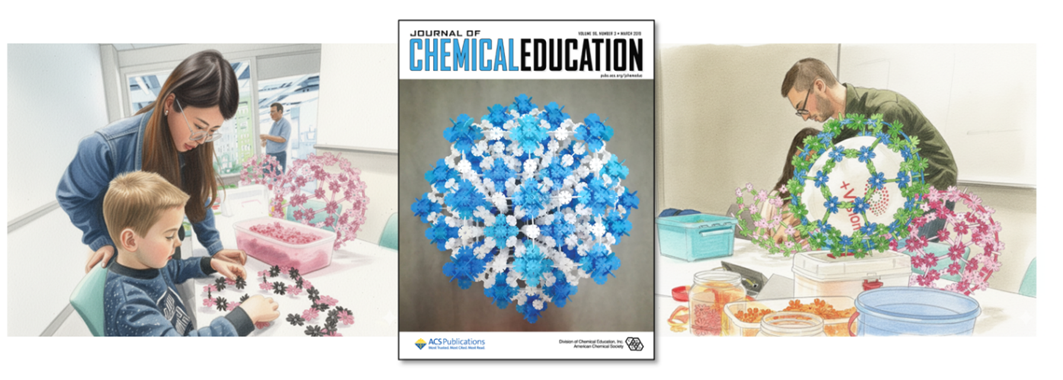
Figure 1: An unlikely source of inspiration. The intuitive way interlocking disk toys are assembled by children sparked the question whether computers be taught the same principles to design new materials?

This insight, that physical toys and complex molecules can share common cognitive blueprints or “assembly models”, became the foundation for Aleksandar’s next step. During his time as a Feodor Lynen Fellow at the University of Cambridge, he formalized this knowledge by developing new ontology and an inductive reasoning algorithm.[1] The combined system maps relationships, learns from curated knowledge, and designs new structures based on predescribed assembly models (Figure 2). This method has led to the rational design of new materials, saving significant experimental and computational costs. Crucially, the approach has been validated: structures from the algorithm’s original predictions have already been successfully synthesized in chemical laboratories.
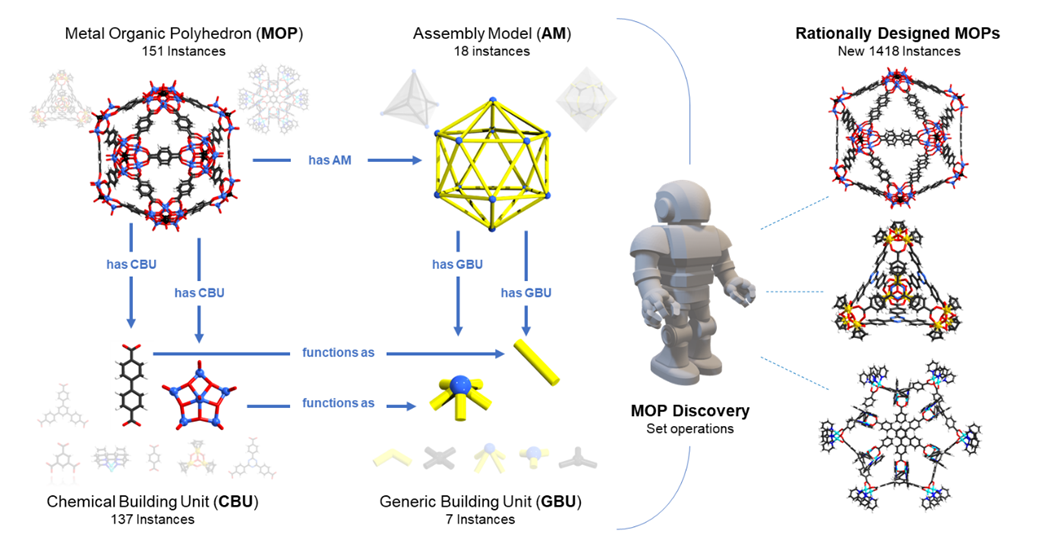
Figure 2: From knowledge to discovery. The system learns the “assembly models” from existing chemical structures and uses this knowledge to computationally predict and design thousands of new, rationally designed materials. [1]

Now at TU Graz, Aleksandar is establishing the Chemical Modelling and Informatics (CheMIn) Group, with the aim of taking assembly modelling to the next level by building a comprehensive knowledge graph. This system will encompass a wide array of material classes, including coordination and organic cages, covalent and metal-organic frameworks, as well as a variety of fully inorganic systems such as zeolites and polyoxometalates. By creating interconnections between these classes, enriching the graph with their synthesis and assembly principles, and adding new computational insights, the platform will provide new possibilities to leverage assembly modelling, automate calculations, and predict synthesis pathways. Ultimately, the goal is to help experimental partners find tailored structures for specific, next-generation applications.
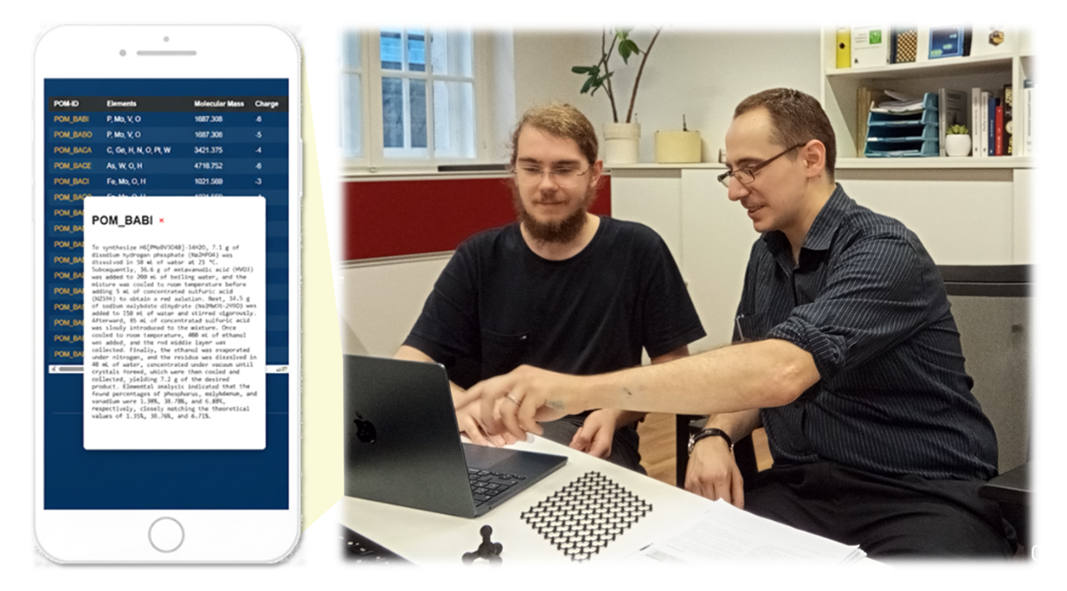
Figure 3: Collaboration in action. Master’s student Jan Leodolter (left) with Aleksandar Kondinski. Jan developed a system to automatically extract and structure hundreds of synthesis protocols from the scientific literature. This valuable data can be easily reviewed through a retrieval-augmented generation (RAG) system he built (inset).

With the kind support of the university and the TU Graz Field of Expertise in Advanced Materials Science, the team has been highly active over the past several months. Working with talented graduate student Jan Leodolter (Figure 3), the team has developed a protocol to automatically extract synthesis procedures. While Jan currently develops the next generation of assemblers and high-throughput quantum-mechanical calculations of the newly predicted materials, Aleksandar has launched the platform https://digital-chemistry.io. The platform currently hosts the largest reference knowledge base for the global polyoxometalate community (Figure 4).[2] Efforts are underway to expand this knowledge base with various reticular materials, with the attention to support other communities working with advanced materials research as well as graduate-level teaching efforts at TU Graz.
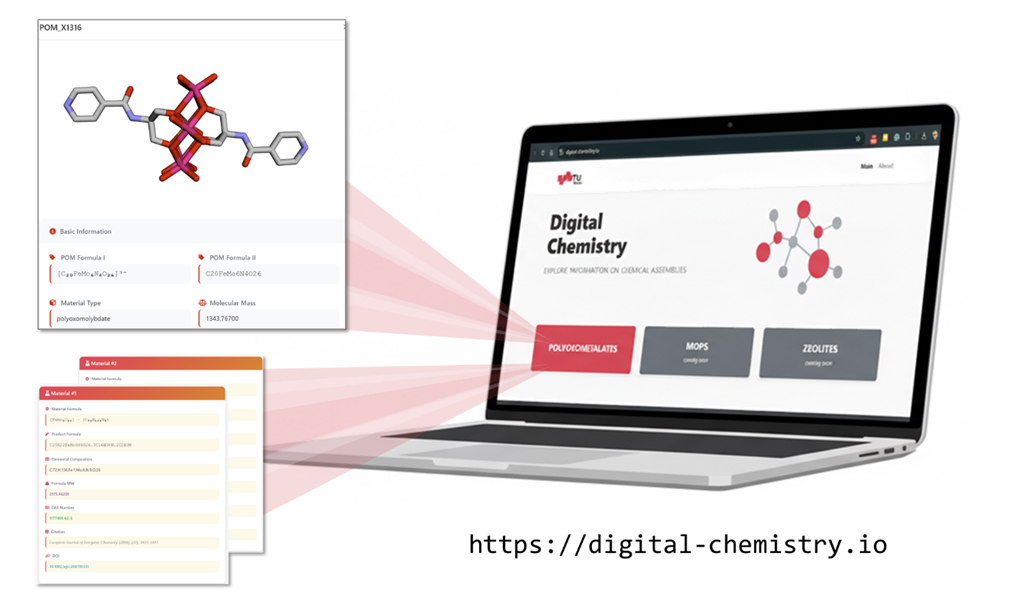
Figure 4: The “Digital Chemistry” platform developed at TU Graz for exploring, sharing, and predicting data on advanced materials.

The long-term vision for the CheMIn Group is to operate at the intersection of two key TU Graz Fields of Expertise: Advanced Materials Science and Information, Communication & Computing. This synergy aligns with the global trend towards creating laboratory digital twins and, eventually, self-driving laboratories. By pursuing this path, the team aims to contribute directly to the university’s strategic focus on digitalization, helping to build the future of automated scientific discovery right here at TU Graz.

REFERENCES

[1] A. Kondinski, A. Menon, D. Nurkowski, F. Farazi, S. Mosbach, J. Akroyd, M. Kraft
“Automated Rational Design of Metal-Organic Polyhedra”
J. Am. Chem. Soc. 2022, 144, 26, 11713–1172.

[2] A. Kondinski, N. Gumerova, A. Rompel, P. Falcaro, T. Schreck
“Data-Driven Polyoxometalate Chemistry”
Chem. Eur. J. (in print, DOI 10.1002/chem.202501528)

Systems Thinking in Inorganic Chemistry

In computational mass spectrometry, linking a mass spectrometry signal to a chemically sound structure is often challenging, particularly for inorganic and nanomolecular systems. This is because compounds with coordination bonds have multiple modes of connectivity.

Recently, we published a study in Chemical Science that addressed this challenge in the context of complex and multinuclear inorganics made of vanadium, arsenic and oxygen atoms. These inorganic molecules belong to the family of spherical heteropolyoxovanadates (heteroPOVs), known for their catalytic activity and magnetic responsiveness. However, determining the structure of the molecules detected by mass spectrometry initially seemed impossible due to the over 40,000 possible configurations for spherical heteroPOVs.

Instead of trying to search through all possibilities exhaustively, we employed a systems thinking approach by combining empirical evidence on formed structures with the role of intramolecular strains caused by substitution configurations. This allowed us to narrow down a set of promising structures, ultimately making cost-efficient calculations and giving a basis to allocate a viable molecular model that correlates with experimental observations. The study also revealed an unexpected structural change: when spherical heteroPOVs are gradually over-substituted with arsenic, the overall structure changes to a cyclic assembly.

 
Composition-driven archetype dynamics in polyoxovanadates
Kondinski, M. Rasmussen, S. Mangelsen, N. Pienack,   V. Simjanoski,   C. Nather,   D. L. Stares,   C. A. Schalley, W. Bensch
Chem. Sci. 13, 6397-6412 (2022)
.

Polyoxometalates and Metal-Metal Bonds

In general, metal-metal bonds are absent in polyoxometalate architectures. However, their emergence becomes highly important for devising functional polyoxometalates in energy conversion, electron storage, and various POMtronics.

Two of our recent articles have been accepted in the Nanoscale Journal Group (RSC).  Considering that simulation packages are involved in the description of such polyoxometalates, our work has been recently highlighted by the company Software for Chemistry and Materials (SCM).

Transformable Polyoxometalates, Sustainable Nanoelectronics


ILDs – YouTube Channel

A channel with tutorials on the building of Models based on Programmable Interlocking Disks has been recently opened on Youtube. Consider subscribing for more videos. 🙂

Building a C60 Fullerene with 6-fold Grooved Programmable Interlocking Disks (ILDs)

Building a Tetrahedron using 8-fold symmetrically grooved Programmable Interlocking Disks (ILDs)


Article featured on Front Cover Eur. J. Inorg. Chem.

Our minireview article has been recently featured on the front cover of Eur. J. Inorg. Chem.

On the front cover we show a selection of mixed‐addenda polyoxometalate structures, along with a hexametalate analogue used in the construction of metal organic frameworks. Isomerism of these mixed‐metal molecular metal oxides is highly complex, often incorporating a wide range of different metals and spanning homo‐ and heterogenous catalysis. Formal metal substitution enables the tuning of specific properties; however, this presents an isomer problem, which has been explored experimentally and computationally.

More information can be found on the journal’s web page.

How can playing with Interlocking Disk Toys benefit your children’s education?

Interlocking Disks (ILDs) are relatively new toys on the market and they are one of the fastest emerging toys in the world. ILDs become instantly recognizable and have a growing fan base. However, have you ever thought that there are educational benefits of ILDs?

Through ILD Education we cooperate with educators and parents over the world to develop discovery-based and teaching experiences at home and in the classroom that bring learning concepts to life. To many people, ILDs are just simple toys and the educational benefits of playing with these colorful multifold symmetrically grooved disks are not always clear. We have identified several key concepts of creating, programming, and crafting with ILDs. The details are given below.

Motor skills with ILDs

Little children practice dexterity when connecting  ILDs. Connoting the different sizes and symmetries of ILDs require different amounts of pressure in order to assemble into a structure. This gives a wonderful exercise for little fingers which supports children in being able to control the pressure they apply later on in school while writing.

Teamwork with ILDs

Through playing with interlocking toys children learn how to share and take turns. When working together on ILDs construction, children have to agree on the general idea of their play – is it a ball, is it a pumpkin or is it a spaceship? During the game, children follow each other’s lead and start to understand how different ideas can make meaningful contributions and extend their play. During playing children also learn how to negotiate and share responsibility in order to enjoy good social experiences.

Creativity and Esthetics with ILDs

ILDs come in many shapes and colors and can be used towards the programming of intricate structural designs. When building with ILDs, children foster their creativity and imagination as virtually there is no limit on what they can build with the ILDs. On the other hand, by building symmetrical structures children get idea on esthetics as they develop eye for spotting irregularities and inconsistences. A combination of colors and imagination provides much space where there is no right or wrong, so children continue exploring without fear of failing.

ILDs develops problem-solving and mathematical thinking

Ideas of symmetry, strain, shape sizes can be explored during play with ILDs. By arranging particular rules and structure design, ILDs provide many benefits for children’s problem solving, focus, and attention to detail. Children experience structure programming reminiscent on that in nature where small pieces interlock into new modular subcomponents with different connectives then the original pieces. They learn how to connect the new subcomponents into structures that are of high interest in Science Technology Engineering and Mathematics (STEM) education.

Improvement of Communication Skills with ILDs

Working with ILDs provides a great way to relieve stress and engage in meaningful and joyful conversations. As children comment on their ILDs creations, they develop important communication skills including the ability to “break down” easily explain their ideas, describe their work, talk about the modeling process, and verbally communicate the challenges they had to overcome.

Developing Persistence with ILDs

ILDs can be used in constructing man scale objects. When constructing big, there are more and more pieces needed, there is a significant increase in manual work, requirement for modular units and if not programmed correctly, large scale structures can fail. ILDs teaches the children the importance of persisting with the aim to see their vision realized. In this regard, ILDs encourage children to have a try, take the time needed, and persevere. As the dexterity and the spatial thinking of the children improve, children can create more elaborate construction and follow complex designs.

Improving Self-esteem with ILDs

Connecting small pieces of ILDs to create a final product that follows a child’s vision can be challenging. As ILDs also provide discovery-based learning, new structure discovery represents an engineering achievement that can significantly improve the self-esteem of the child. When achieving this task, children can get an immense sense of satisfaction that is obvious in their mood and as they proudly show their competed work. This has an immensely positive effect on a child’s self-esteem.

Developing Spatial Thinking and Engineering skills with ILDs

Sometimes building complex architectures with ILDs can require the following of instructions that may be challenging. However, it does help children to develop spatial thinking skills and manage better planning of the structure-building process. In addition, when working with various different pieces and modular units, children develop “fingertips feeling” on the structure stability, which is helpful as it nurtures early engineering skills and insights for little children. When faced with an assembly problem, children have to retrace their steps, examine and analyze their structures in order to find parts that need fixing.

Elected Member of the Council of the Faculty of Science at KU Leuven

I am honored to announce that I have been recently elected as a member  of the fABAP and thus as an AAP and BAP representative at the Council of the Faculty of Science at KU Leuven (Faculteitsraad).  I thank all of the fABAP members for entrusting me.

As part of my mandate over the next years, I am delighted to represent the stands of the fABAP at the Faculteitsraad and to provide a voice to the issues that concern many fellow researchers.

ChemCYS 2018

As part of the Bioinorganic Chemistry Group at KU Leuven, I had a chance to visit the ChemCYS conference where I presented poster contribution on molecular beauty. The conference provided an excellent opportunity to meet Prof. Martyn Poliakoff from University of Nottingham (United Kingdom) who is worldwide known for his effort to popularize chemistry via his YouTube channel. The meeting with him reminded me of the importance of creating chemistry related YouTube videos. An old video from of my son (at the time ca. 2 years) pipetting is shown below. Buch of new videos is coming soon. ?

Go to video: http://www.geoset.info/presentation/our-youngest-scientist/


Paper on Polyoxovanadate Configomers accepted in Angewandte Chemie

A new manuscript dealing with the configurational isomerism problem in polyoxovanadates (POVs) has been accepted for publication in Angewandte Chemie International Edition.

Under very innovative synthetic conditions, Prof. Wolfgang Bensch and his PhD student Ms. Lisa Mahnke (CAU Kiel) have discovered a new extraordinary POV isomer with formula [V14Sb8O42]4-. Compared to the studied isomers in our previous work, this unusual POV exhibits one vanadyl moiety pointing towards the interior of the cluster.

It was soon afterward that was realized that this is not a new single POV structure, but a blueprint of a complex configurational isomerism in POV chemistry. Insights into the relative stability of the possible forming species and comparison of fragment transfer between the reactant molecules and the product have rationalized why this particular isomer forms and what other isomers are most likely to be isolated in near future.

The overall study has been further complemented by magnetochemical experiments (Prof. Paul  Kögerler, RWTH Aachen) and ESI-MS studies (Prof. Schalley, FU Berlin).


FWO Postdoctoral Fellowship for Development of Novel Artificial Proteases

The journey in science never stops. Now, it goes further west.

The Research Foundation Flanders (FWO) has recently awarded me with a postdoctoral fellowship! From January 2018 I will be proudly joining the Laboratory of Bioinorganic Chemistry at KU Leuven, led by Prof. Dr. Parac-Vogt.

Continue reading “FWO Postdoctoral Fellowship for Development of Novel Artificial Proteases”

RWTH Start-up Grant for the Development of All-inorganic Nanomolecular Switches

RWTH Aachen has recently informed that will award a Start-up fund of ca. 18 000 € to Dr. Stuckart and myself. The RWTH Start-up funds are awarded to postdoctoral research fellows in all disciplines aiming at independent academic careers. Our proposal, supported by Prof. Dr. Paul Kögerler, has ranked among the 15 most innovative and promising postdoctoral Start-up applications at RWTH Aachen University.

The joint proposal addresses development of a new kind of nanomolecular switches based on polyoxometalates. Dr. Stuckart and myself are looking forward to our first joint publication and to many other exciting project results afterwards.

Paper accepted for publication in Dalton Transactions

Very recently Dalton Transactions approved our paper for publication:
The Cu(I)-catalysed Huisgen 1,3-dipolar cycloaddition route to (bio-)organic functionalisation of polyoxovanadates.

This paper describes a new route towards the preparation of (bio-)organic functionalized Lindqvist-type polyoxovanadates and based on density functional calculations it explains how the properties of these compounds are tailored by the attached functional moieties.

POM Highlights: New Lindqivst-type polyoxocuprates

Abstract ImageAs we have indicated, polyoxocuprates are en emerging class of POM-materials that will have impact on material sciences, especially on the design of novel metal organic frameworks.

Recenty Li, Zheng and coworkers have reported on a new Lindqvist-type polyoxocuprate (Inorg. Chem., 2017, 56 (8), pp 4635–4642). These polyoxocuprates are stabilized by cadmium(II) or manganese(II) cations and templated using tris-type ligands. The Mn(II) containing derivatives assemble into extended framework materials.

Concept paper in print

POCus – Frontispiece

The concept paper on polyoxocuprates (POCus) just recently came out in print in the Special 750th Issue of Chemistry – A European Journal! 🙂

The design of the frontispiece is inspired by the legend of the Gordian Knot associated with Alexander the Great. In the current work we used it as a metaphor for solving an intractable problem in polyoxometalate chemistry by “thinking outside the box”.


How can we develop Wikipedia articles that we can trust?

Information share and quality education are core prerequisites for a global prosperous future. However, much of the world that needs these commodities cannot afford them. Over the past sixteen years, Wikipedia has served to educate and share information. Unfortunately, its role in the world education is still rarely acknowledged by the academic community. In this short article, I simply discuss my view on the issue and propose a way to improve it.

Continue reading “How can we develop Wikipedia articles that we can trust?”