Styria produced Arnold Schwarzenegger, and his “Terminator” defined a single-minded resolve. Now the world needs that resolve for creation. Can we, at TU Graz, build an intelligent AI, a “Cheminator”, that helps us unlock key breakthroughs in advanced material science?
Originally published in TU Graz research, 2025-2, Issue 34, pp. 20–22. Read article (PDF) · View original magazine
About a year ago, while in Cambridge, Aleksandar Kondinski received a long-awaited email from the appointments committee. The news was electrifying. After holding posts in Germany, the UK, Belgium, and Singapore, he was coming to the tech-savvy TU Graz for a position as an Assistant Professor in Computational and Digital Chemistry.
Before the 2020 pandemic, Aleksandar’s research focused on molecular engineering guided by computational techniques. The inspiration for a new direction came from an unexpected place. It all started when his son showed him a new toy, a set of inexpensive interlocking disks from a German retailer. While they were playing together, he realised these simple blocks could be used in chemical education for the construction of complex models resembling the structure of nanoscale architectures (Figure 1). The educational potential of this idea was confirmed in hands-on workshops, leading to two publications in the Journal of Chemical Education. This entire experience sparked the pivotal question that now drives his research: If the construction principles are so intuitive that a child can grasp then, could a computer be taught the same principles and be empowered to design and tailor entirely new materials?
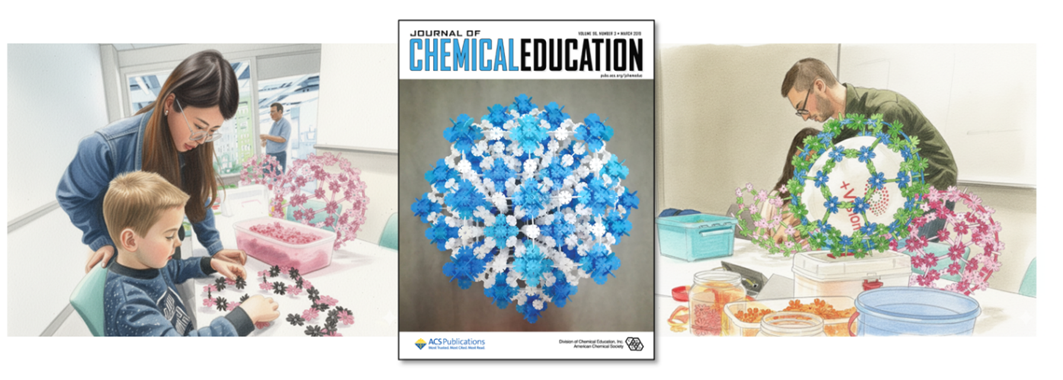
Figure 1: An unlikely source of inspiration. The intuitive way interlocking disk toys are assembled by children sparked the question whether computers be taught the same principles to design new materials?
This insight, that physical toys and complex molecules can share common cognitive blueprints or “assembly models”, became the foundation for Aleksandar’s next step. During his time as a Feodor Lynen Fellow at the University of Cambridge, he formalized this knowledge by developing new ontology and an inductive reasoning algorithm.[1] The combined system maps relationships, learns from curated knowledge, and designs new structures based on predescribed assembly models (Figure 2). This method has led to the rational design of new materials, saving significant experimental and computational costs. Crucially, the approach has been validated: structures from the algorithm’s original predictions have already been successfully synthesized in chemical laboratories.
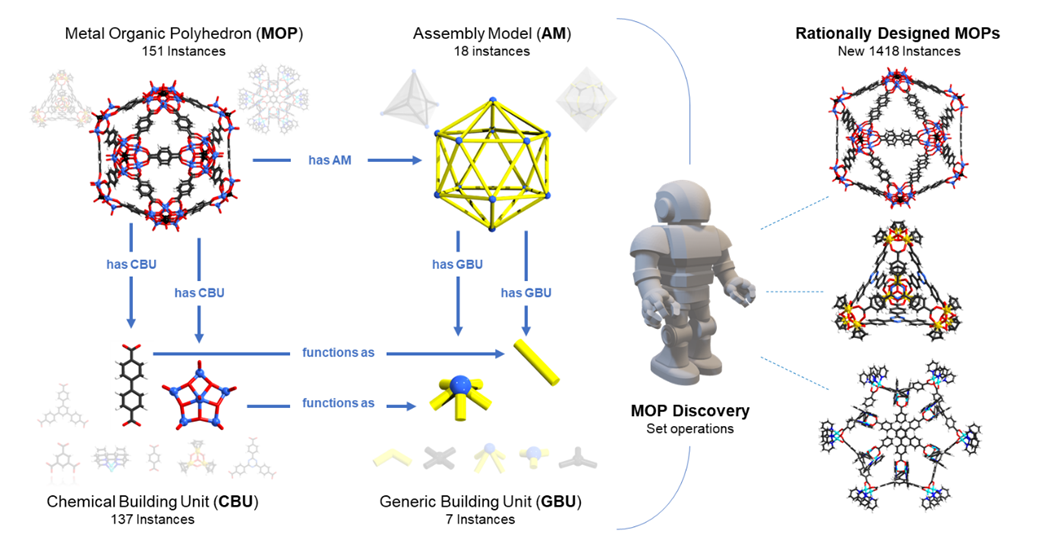
Figure 2: From knowledge to discovery. The system learns the “assembly models” from existing chemical structures and uses this knowledge to computationally predict and design thousands of new, rationally designed materials. [1]
Now at TU Graz, Aleksandar is establishing the Chemical Modelling and Informatics (CheMIn) Group, with the aim of taking assembly modelling to the next level by building a comprehensive knowledge graph. This system will encompass a wide array of material classes, including coordination and organic cages, covalent and metal-organic frameworks, as well as a variety of fully inorganic systems such as zeolites and polyoxometalates. By creating interconnections between these classes, enriching the graph with their synthesis and assembly principles, and adding new computational insights, the platform will provide new possibilities to leverage assembly modelling, automate calculations, and predict synthesis pathways. Ultimately, the goal is to help experimental partners find tailored structures for specific, next-generation applications.
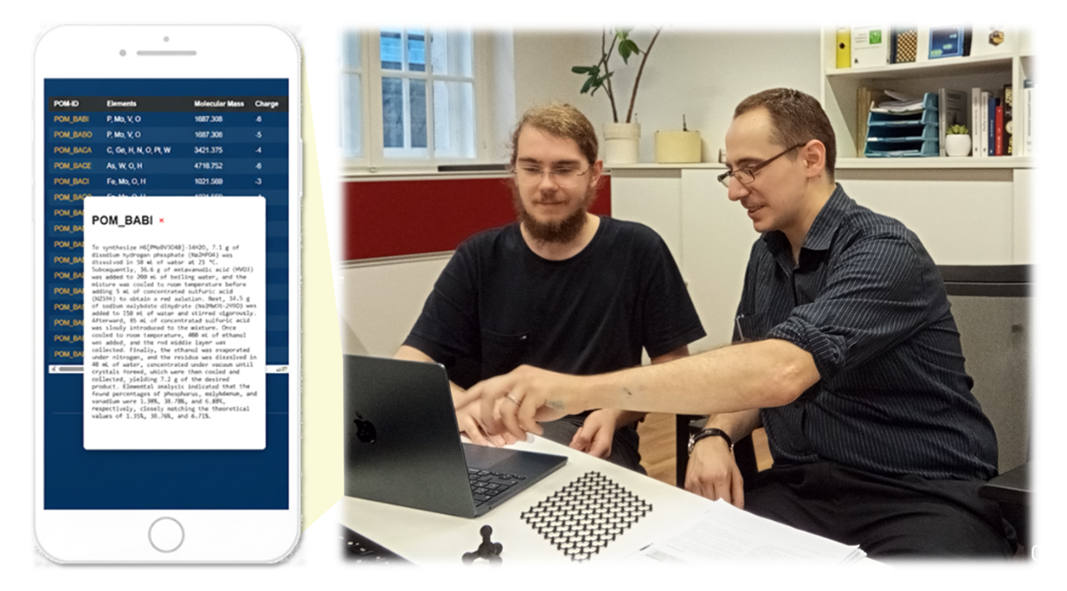
Figure 3: Collaboration in action. Master’s student Jan Leodolter (left) with Aleksandar Kondinski. Jan developed a system to automatically extract and structure hundreds of synthesis protocols from the scientific literature. This valuable data can be easily reviewed through a retrieval-augmented generation (RAG) system he built (inset).
With the kind support of the university and the TU Graz Field of Expertise in Advanced Materials Science, the team has been highly active over the past several months. Working with talented graduate student Jan Leodolter (Figure 3), the team has developed a protocol to automatically extract synthesis procedures. While Jan currently develops the next generation of assemblers and high-throughput quantum-mechanical calculations of the newly predicted materials, Aleksandar has launched the platform https://digital-chemistry.io. The platform currently hosts the largest reference knowledge base for the global polyoxometalate community (Figure 4).[2] Efforts are underway to expand this knowledge base with various reticular materials, with the attention to support other communities working with advanced materials research as well as graduate-level teaching efforts at TU Graz.
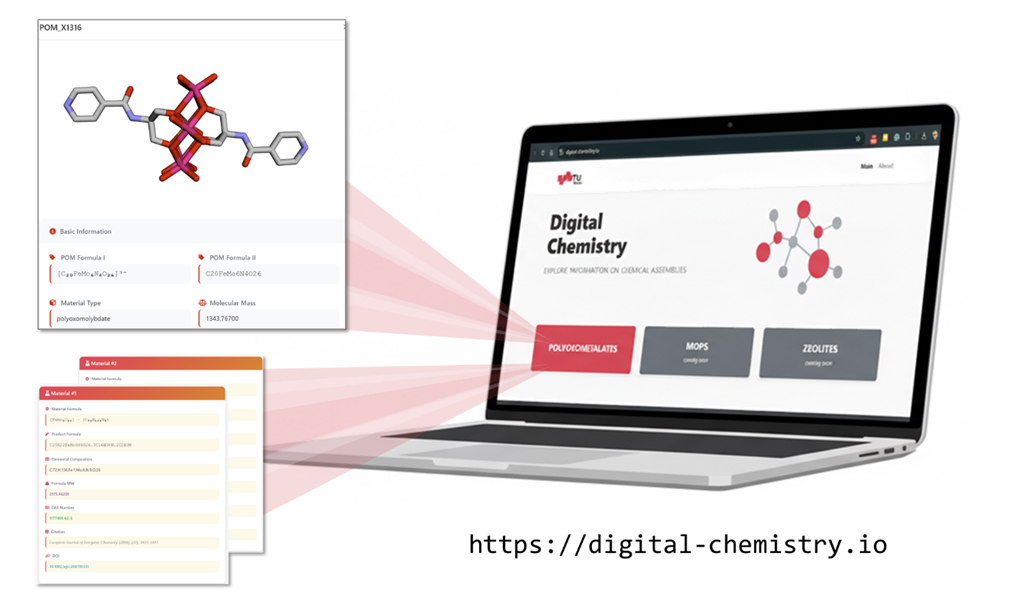
Figure 4: The “Digital Chemistry” platform developed at TU Graz for exploring, sharing, and predicting data on advanced materials.
The long-term vision for the CheMIn Group is to operate at the intersection of two key TU Graz Fields of Expertise: Advanced Materials Science and Information, Communication & Computing. This synergy aligns with the global trend towards creating laboratory digital twins and, eventually, self-driving laboratories. By pursuing this path, the team aims to contribute directly to the university’s strategic focus on digitalization, helping to build the future of automated scientific discovery right here at TU Graz.
REFERENCES
[1] A. Kondinski, A. Menon, D. Nurkowski, F. Farazi, S. Mosbach, J. Akroyd, M. Kraft
“Automated Rational Design of Metal-Organic Polyhedra”
J. Am. Chem. Soc. 2022, 144, 26, 11713–1172.
[2] A. Kondinski, N. Gumerova, A. Rompel, P. Falcaro, T. Schreck
“Data-Driven Polyoxometalate Chemistry”
Chem. Eur. J. (in print, DOI 10.1002/chem.202501528)