We develop computational, knowledge-driven and experimental-digital approaches for exploring chemical structure, function and technology. Our research connects computational chemistry and chemical-space exploration with knowledge engineering, artificial intelligence, molecular assembly, laboratory automation and tools for chemistry education.
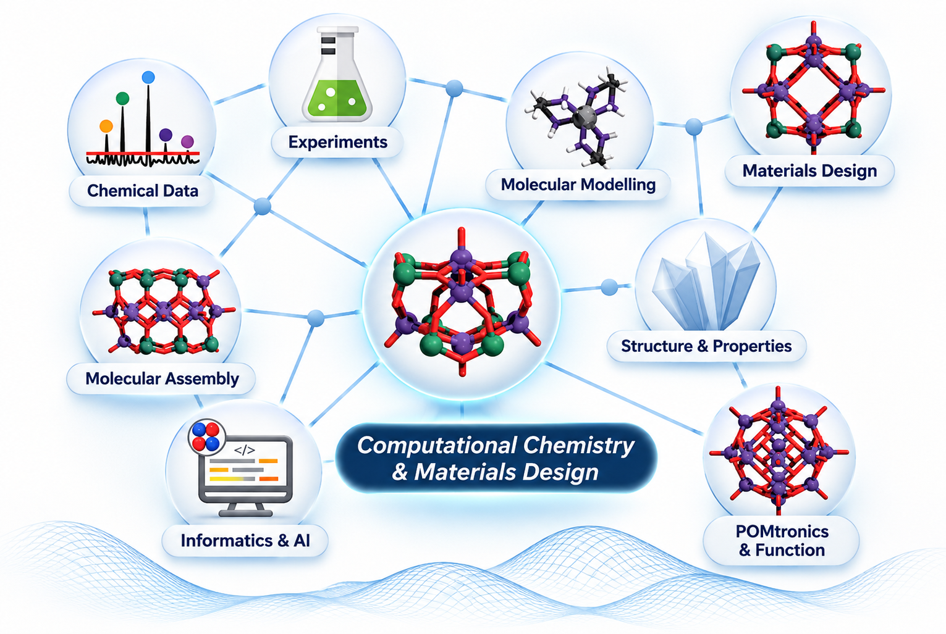
Computational chemistry provides the molecular-level foundation of our research. We use quantum-chemical calculations, molecular modelling and structural analysis to investigate relationships between composition, molecular structure, stability, bonding and electronic behaviour in inorganic and hybrid systems.
A particular interest is algorithmic exploration of chemical space. Structural enumeration, symmetry, connectivity and chemically informed constraints can reduce very large configurational spaces to manageable sets of plausible structures. We use such approaches to study configurational isomerism, substitution patterns, competing structural motifs and composition-dependent transformations.
We also investigate how changes in bonding and electronic structure generate molecular function. Polyoxometalates are an important platform for this work. Examples include Pt12 polyoxoplatinates showing redox-responsive covalent dynamics through reversible Pt-Pt bonding. Related studies address electron storage, metal-metal bonding, molecular electronics, photochemical behaviour and catalytic reactivity in molecular metal-oxide systems.
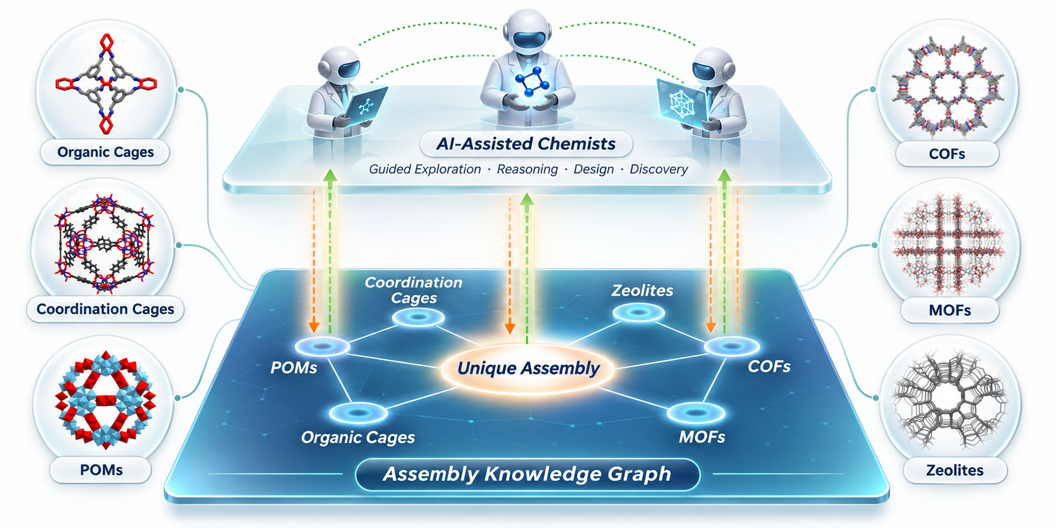
Chemical knowledge is distributed across molecular structures, synthesis procedures, calculations, experimental observations, publications and databases. We investigate how this information can be organised computationally while preserving the chemical relationships that give it scientific meaning.
Our work in knowledge engineering and chemical informatics includes structured datasets, ontologies and knowledge graphs linking compounds, structures, properties, experiments and computational results. These representations support chemical information retrieval, integration of heterogeneous data and machine-assisted reasoning across complex chemical domains.
We combine these ideas with artificial intelligence and assembly modelling. Computational models are used to describe how molecular building blocks connect and assemble, allowing families of candidate structures to be generated and evaluated systematically. Machine learning, language models and AI agents are then connected with structured chemical knowledge, databases and computational tools so that resulting hypotheses and workflows remain traceable, interpretable and open to validation.
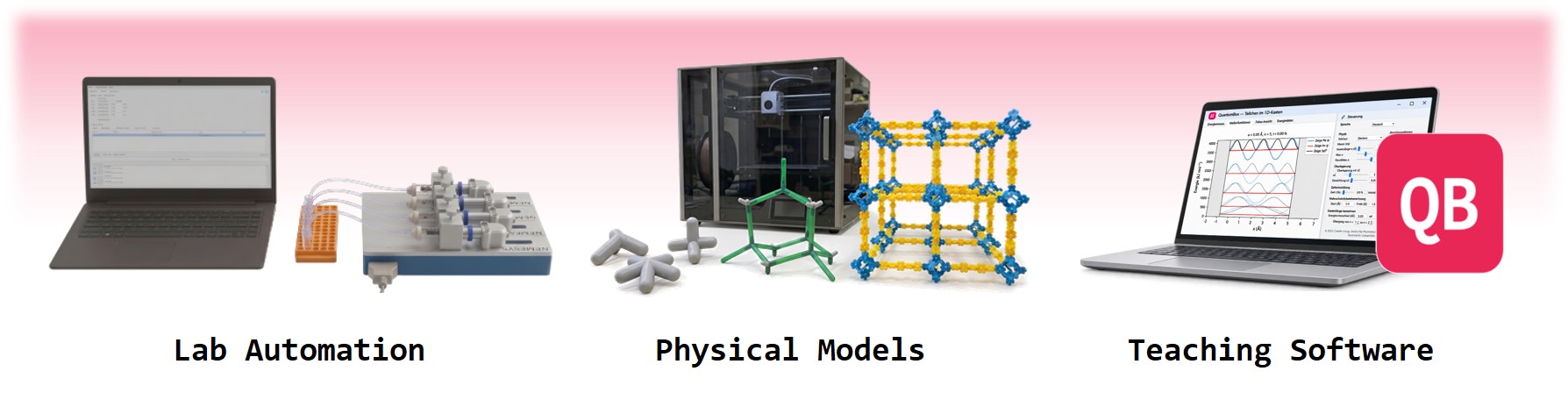
We develop tools that connect digital chemistry with laboratory practice and chemistry education. These range from software and physical molecular models to programmable experimental systems, with a common focus on making chemical processes easier to explore, reproduce and understand.
In the laboratory, our interests include automation and digitally controlled experimentation. Modular hardware, programmable liquid handling, computer-controlled workflows and structured data capture can connect experimental operations directly with digital chemical information and support reproducible, scalable experimental workflows.
We also develop interactive teaching software and physical models. QuantumBox provides an interactive environment for exploring concepts from quantum chemistry, while modular and 3D-printed construction systems make molecular geometry, connectivity and framework assembly tangible. Together, these tools help connect mathematical, computational, structural and experimental representations of chemistry.